
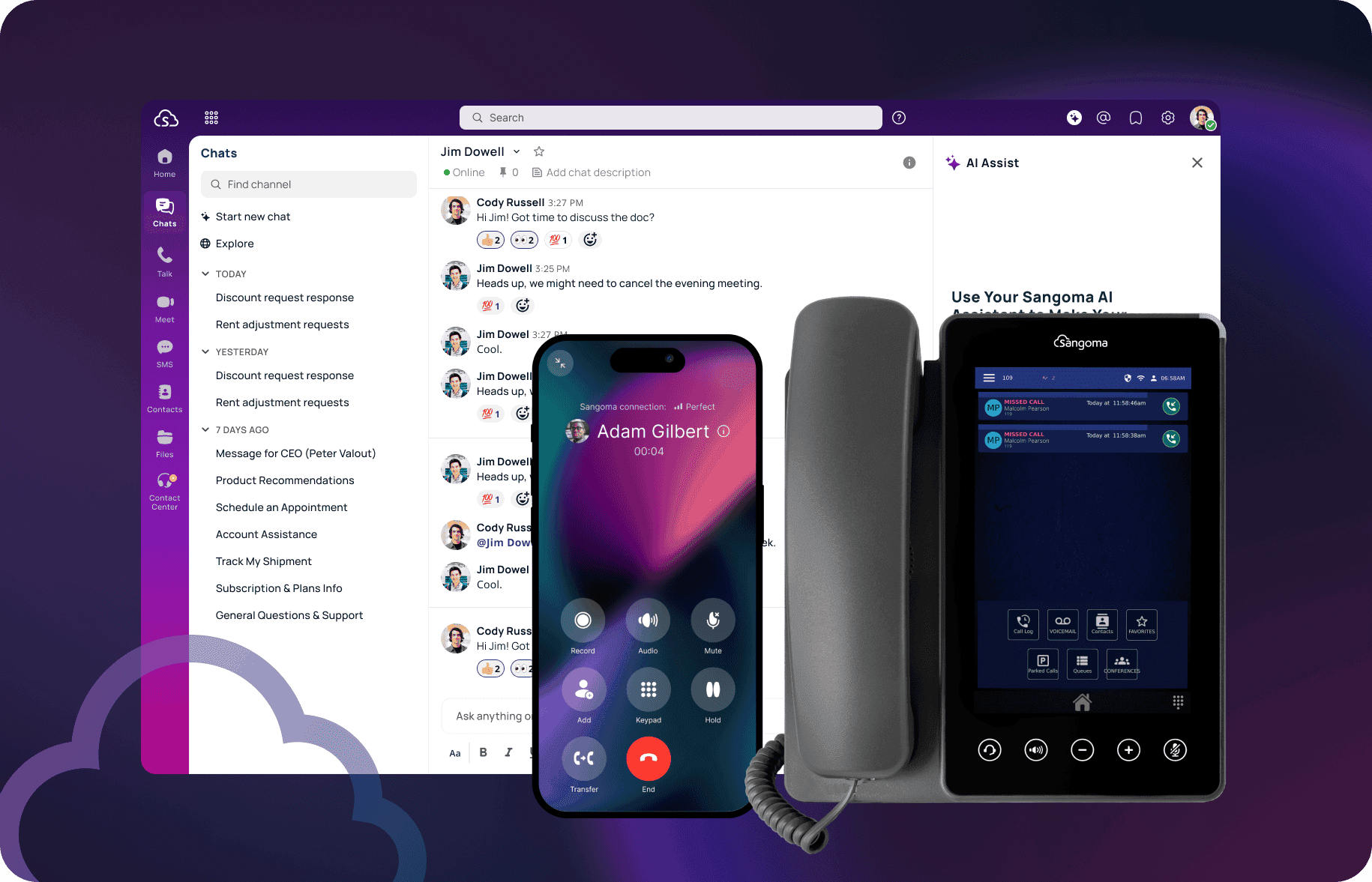
Unified Communications (UC) often forces businesses to make a difficult choice: the control and security of an on-premises system, or the agility and scalability of a cloud solution. What if you didn’t have to choose?
Hybrid unified communications offers precise control over critical infrastructure while leveraging cloud flexibility for effortless scaling.
In this article, we’ll explain why hybrid UC truly offers the best of both worlds, enabling businesses to grow without sacrificing control.
Key takeaways
- Hybrid UC combines cloud scalability and on-premises control, without compromise.
- It is ideal for organizations that need to secure sensitive data while supporting growth and remote work.
- The right deployment starts with a genuine assessment of communication needs, not with buying more technology.
- Solid network planning and built-in redundancy are essential for performance from day one and long-term reliability.
- Security, compliance, and user training must be part of the plan, not an afterthought.
- Ongoing monitoring and responsive support keep hybrid UC effective after launch.
- With careful planning, hybrid UC becomes a long-term asset, not a makeshift solution.
What is hybrid UC?
Hybrid UC combines the best of on-premises and cloud-based communication solutions (UCaaS) in one powerful system. Instead of choosing between complete on-site control and cloud flexibility, hybrid UC gives you both. You keep essential infrastructure on site—ideal for compliance and control—while taking advantage of cloud scalability when you need it.
But it is not just a matter of convenience. Hybrid UC also gives you a safety net. Sangoma’s hybrid platforms include business continuity features such as local survivability and automatic failover. If the internet goes down or a service fails, internal calls still go through and your team stays connected. This reliability is crucial—especially when a communications outage means lost revenue or missed opportunities.
Businesses that adopt hybrid UC gain the control they need, the flexibility they want, and the availability they can rely on.
Discover how Sangoma’s hybrid UC solutions help businesses achieve both scalability and control.
Key components of hybrid UC
Hybrid UC connects your existing local devices—business phones, intercoms, or alert systems—to cloud tools such as voice, messaging, and video conferencing. It delivers everything through a unified interface, enabling IT teams to manage on-site and remote communications from a single platform.
By combining these components, you get a flexible, scalable, and secure communications system that accelerates your business’s growth.
Benefits of a hybrid UC system: the best of both worlds
Hybrid UC is designed to give businesses the combined strengths of on-site and cloud solutions—scalability, control, reliability, and flexibility without compromise.
Scalability and flexibility
Hybrid UC grows with your business. Whether you add new offices, expand your workforce, or support remote teams, a hybrid approach ensures your communications infrastructure adapts quickly. Cloud services add flexibility, allowing rapid deployment of new tools, features, and user capabilities as your business evolves.
Greater control & security
Hybrid UC gives your business tighter control over sensitive communications and critical data. With core infrastructure on site, you have complete visibility into data management—while built-in security features such as end-to-end encryption, strong authentication, and compliance tools help protect everything.
It also supports local Quality of Service (QoS) for voice traffic, prioritizing calls on the network to prevent jitter, lag, and dropped calls. This means clearer conversations and fewer disruptions, even during periods of heavy use.
Business continuity & disaster recovery
Downtime is unaffordable for modern businesses. Hybrid UC protects operations through built-in redundancy, on-site survivability, and multiple failover mechanisms such as 4G LTE and POTS lines. If the cloud system experiences interruptions, your on-site system automatically takes over, maintaining communications continuity and ensuring your business remains operational even during unexpected outages or disasters.
Deployment flexibility and interoperability
Adopting a hybrid UC model enables you to create a communications network that adapts automatically during disruptions. If a problem occurs, your systems switch between the cloud and on‑premises, keeping your operations intact. This approach removes the need to choose between the two, providing a reliable solution that supports your goals and ensures uninterrupted communication.
When is a hybrid UC system the right choice?
Hybrid UC is a smart solution if your business needs:
- Flexibility and control over sensitive data: If you are in healthcare, finance, or government, keeping critical data on site gives you tighter control—while using the cloud to scale quickly when needed.
- Support for distributed teams: If you have multiple offices or remote teams, hybrid UC lets everyone communicate seamlessly while giving your IT team centralized control and management.
- Strict data residency or compliance requirements: Some data simply cannot leave the building. Hybrid UC lets you keep those data flows local while using the cloud for everything else.
- Reliable voice communications for critical environments: Hybrid UC includes on‑site survivability and automatic failover options, so internal calls continue even during internet outages—avoiding interruptions when availability is critical.
- Room to grow without overhauling infrastructure: Scale at your own pace. Add cloud tools as you go while keeping your local systems running without interruption.
Hybrid UC vs Cloud UC vs On‑Premises UC
Choosing between hybrid UC, cloud UC (UCaaS), and on‑premises UC comes down to prioritizing your needs. On‑premises UC gives you maximum control and security but lacks flexibility and easy scalability. Cloud UC, on the other hand, offers simplicity and fast scalability but may compromise customization and control.
Hybrid UC strikes the right balance—giving you precise control over sensitive data with on‑site hardware, while using cloud services for rapid scalability and greater agility.
Here is a quick comparison:
| Feature | Hybrid UC | Cloud UC (UCaaS) | On‑Premises UC |
|---|---|---|---|
| Scalability | High | Very High | Limited |
| Control & Security | High | Moderate | Very High |
| Deployment Speed | Fast | Fastest | Slow |
| Customization | High | Moderate‑Low | Very High |
| Management Complexity | Moderate | Low | High |
| Cost Structure | Balanced (CapEx + OpEx) | Predictable (OpEx) | High upfront (CapEx) |
| Business Continuity | Excellent (Built‑in redundancy) | Good | Depends on internal redundancy |
For an in-depth review of choosing the best UC model for your business, see our Ultimate Guide to Unified Communications.
Best practices for implementing a hybrid UC system
Implementing a hybrid UC system can transform your business communications—but careful planning ensures success. Follow these best practices to get started:
1. Start with a real needs assessment—not assumptions
Before touching the technology, audit your communications landscape. Look for:
- Gaps in current workflows (e.g., frequent dropped calls, scattered tools, missed messages).
- Workforce structure: Are your teams in the office, remote, or hybrid? Do they switch devices throughout the day?
- Compliance requirements (especially if you are in healthcare, education, or finance).
- Legacy infrastructure: What do you need to keep? What is holding you back?
Tip: Involve IT and department heads from the start. You will uncover requirements that top‑down plans often miss.
2. Choose a UC partner that offers more than just “flexibility”
Your hybrid UC platform should do more than just tick a box. Look for:
- Built-in failover options such as 4G LTE backup or local survivability (Sangoma’s StarBox® handles this well).
- Support for mobile and remote workers — including apps that truly sync across devices.
- An integration-ready architecture: CRMs like Salesforce, Microsoft Teams, and custom workflows shouldn’t require workarounds.
- Single, transparent support — no finger-pointing when an outage occurs.
- Exceptional reliability: aim for at least 99% availability, ideally 99.999%, to ensure your communication systems are always available.
Warning sign: If a provider can’t clearly explain how voice, video, chat, and file sharing work together, move on.
See also: Comparing UCaaS Providers
3. Prepare your network for hybrid
Hybrid UC lives or dies by your infrastructure. Here’s what to check:
- Bandwidth: make sure you have headroom, especially for simultaneous video and VoIP traffic.
- QoS: prioritize voice traffic. This isn’t optional — poor call quality kills productivity.
- Hardware compatibility: confirm that your phones, routers, and firewalls can handle SIP traffic and cloud signaling.
- Multiple internet/failover paths: LTE or secondary WAN lines keep you running even if your ISP fails.
Smart addition: Consider Sangoma’s Managed Network and SD-WAN to ensure availability and improve VoIP performance.
4. Security and compliance
Don’t leave security as an afterthought. If your hybrid UC setup handles sensitive data — medical records, financial transactions — lock it down from the start.
Prioritize:
- End-to-end encryption for voice, video, chat, and file sharing — at rest and in transit.
- Role-based access controls (RBAC): limit access according to roles, not just credentials.
- Secure mobile clients: ensure your mobile apps enforce the same policies as desktops — PIN lock, remote wipe, encrypted storage.
- HIPAA, PCI-DSS readiness: your platform should make compliance easier, not turn it into a patchwork.
- Audit logs and real-time monitoring: track who accessed what, when, and from where. Alerts should flag any anomaly.
- Security continuity during failover: even during an outage, your backup systems (LTE or on-site failover) must maintain encryption and call control.
5. Staff training and user adoption
A great UC system fails if no one knows how to use it. Employee buy-in speeds up productivity gains and eases the transition.
Plan for:
- End-user onboarding with real use cases — how to start a video meeting from chat, how to transfer a call to mobile, etc.
- Administrator training to monitor availability, adjust call flows, and manage permissions.
- Ongoing access to support — make sure your teams know where to go when they hit a roadblock.
Tip: Use Sangoma’s 24/7 support and TeamHub’s built-in AI assistant (@ASKSangoma) to reduce support tickets and speed up onboarding.
6. Monitor, measure, optimize
Your UC system should evolve with your business. Once it’s live:
- Review call analytics regularly to spot bottlenecks or service gaps.
- Audit device usage: see which tools help and which remain unused.
- Refine call routing and IVRs based on customer and agent feedback.
- Test your failover plan every quarter. Don’t wait for a real outage.
If you’re using Sangoma’s hybrid UCaaS, you can adjust features without removing the hardware. This agility is crucial for growing teams.
7. Choose truly responsive support
Finally, don’t underestimate the value of solid technical support. Choose a provider that offers responsive assistance, proactive troubleshooting, and ongoing maintenance.
Look for:
- Live support — not just chatbots or tickets with replies in 2 days.
- Proactive monitoring and alerts : problems should be reported before users notice them.
- Onboarding and migration assistance : especially if you are coming from a mix of legacy systems.
- Clear documentation and training resources : your IT team should not have to guess.
- Long-term maintenance plans : updates, patches, hardware compatibility checks — everything is taken care of.
Why Sangoma ? You get real-time help from the people who built the system — not a third-party call center. Our in-house support team is available 24/7, and you have a single point of contact for everything — from your phones to your failover.
Industries that benefit from hybrid UC
Hybrid UC solutions are versatile and ideal for several sectors, especially where balancing control and scalability is crucial. Here is how different sectors benefit from them :
Healthcare
Hospitals and clinics depend on secure communication and compliance with strict regulations such as HIPAA. Hybrid UC allows healthcare providers to manage patient information securely on premises while harnessing cloud flexibility for telehealth and remote collaboration.
Explore our Healthcare UC Solutions
Retail
Retail businesses with multiple stores or online operations need streamlined communication. Hybrid UC connects locations easily, supports rapid scaling during peak seasons, and secures sensitive customer and transaction data.
Education
Educational institutions benefit from hybrid UC through enhanced collaboration across campuses, remote learning flexibility, and centralized control over sensitive student information. This simplifies administration and ensures reliable communications.
Explore Education UC Solutions
Manufacturing
Manufacturers often manage multiple sites with mission-critical systems on premises. Hybrid UC improves real-time communication between plants, warehouses, and offices while maintaining strict security around proprietary data.
Explore Manufacturing Solutions
Hospitality
Hotels and hospitality businesses require reliable, scalable communication tools. Hybrid UC enables centralized management of guest services, supports rapid growth during peak seasons, and ensures a consistent, high-quality guest experience across all locations.
Is hybrid UC right for your business ? Find out now !
Hybrid UC offers the ideal blend of scalability, control, flexibility, and security — perfectly suited to the evolving needs of modern businesses. If you are looking for a communication solution that grows easily, protects sensitive data, and adapts quickly to changing demands, hybrid UC could be your answer.
Consider your organization’s unique needs : do you need robust security and compliance, rapid scaling, or simplified management across multiple sites ? If so, Sangoma’s hybrid UC solutions can provide exactly that, tailored specifically to your business.
Get in touch with Sangoma today and discover how hybrid UC can transform your communication strategy.
Additional links: