
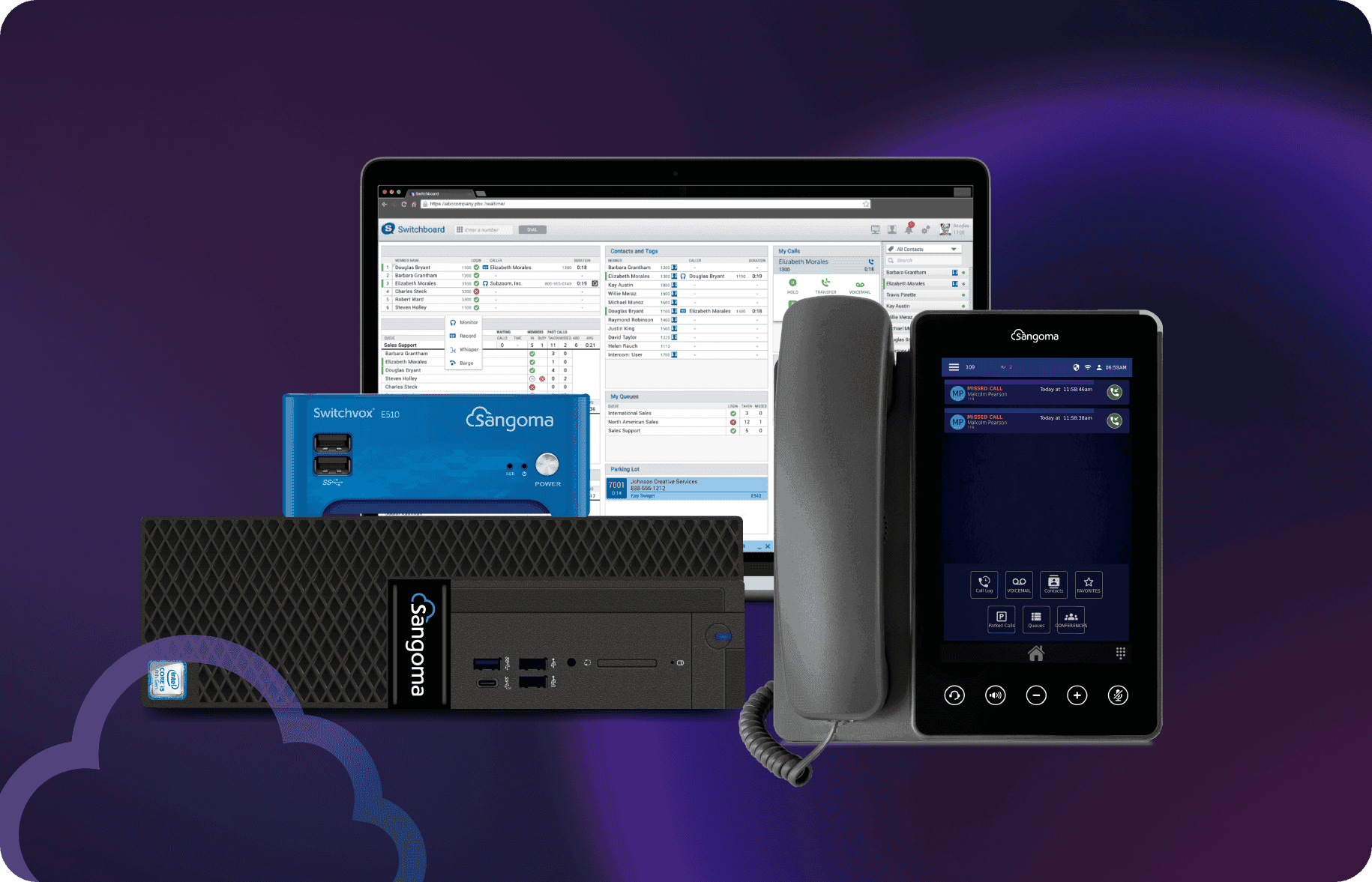
For industries with rigorous compliance requirements or data sovereignty concerns, keeping communications infrastructure in-house can provide additional peace of mind. On-Premises Unified Communications (UC) gives you full administrative control over updates, integrations, and data—without sacrificing the collaboration features teams need.
While cloud and hybrid deployments are secure and scalable (and often suitable for many businesses), some organizations still need the certainty of managing everything on-site. Sangoma’s on-prem systems provide that assurance—along with long-term savings and complete integration with existing hardware.
Do you need help choosing the UC configuration that’s right for your business?See our comprehensive Unified Communications Solutions Guide_.
What is an on-premises unified communications system?
An on-premises UC system is an enterprise communications platform hosted entirely on-site, meaning all data, hardware, and software are managed in-house. This setup gives organizations complete autonomy over their communications network, ensuring compliance with strict regulations and reducing reliance on third-party providers. It integrates voice, video, messaging, and collaboration tools within a private infrastructure, ensuring maximum security and performance.
Why do regulated industries favor on-premises UC
Data Security and Compliance
Regulated industries must comply with very strict data security guidelines, and on-premises UC ensures data sovereignty by keeping sensitive information within the company's infrastructure. It uses high-level encryption to protect calls, messages, and video conferences, thereby reducing any unauthorized access. In addition, companies can meet compliance requirements for laws such as HIPAA (healthcare) and PCI‑DSS (finance) without relying on external providers.
Control over communication infrastructure
Unlike cloud UC, where providers dictate security protocols, updates, and pricing, on-premises UC puts businesses in the driver's seat. Organizations avoid vendor lock-in, adapt security measures, and retain full control over system updates and configurations. This autonomy ensures greater reliability and reduces risks associated with external providers.
Fewer outages and surprises
Many businesses encounter unexpected challenges with certain cloud providers, such as sudden price increases or service outages. This is one reason regulated industries often lean toward on-premises UC: they can monitor availability internally and keep control of their environment.
That said, Sangoma's own cloud and hybrid systems are designed differently—with 99,999 % availability and built-in redundancy to keep your business running without interruption. For teams that need local survivability and the flexibility of remote access, Sangoma offers a unique hybrid deployment option.
Ease of compliance with industry-specific requirements
For nearly every business, compliance is not optional; it is a necessity. An on-premises UC system simplifies compliance by supporting industry-specific security policies, retaining detailed audit logs, and enabling local data storage to meet legal requirements.
Budget considerations and long-term investment
Although on-premises UC requires a larger upfront investment, it often proves more cost-effective in the long term. Businesses save by eliminating recurring subscription fees and taking full control of maintenance and updates. Unlike cloud-based models, which often increase costs over time, on-premises UC offers predictable expenses and avoids external price fluctuations.
Regulated industries that can benefit from on-premises UC deployment
Healthcare
With HIPAA regulations requiring strict protection of patient data, on-premises UC helps secure telehealth consultations, protect medical records, and encrypt patient communications. Healthcare providers can ensure compliance without relying on third-party cloud services.
_See _Sangoma’s UC solutions for healthcare.
Retail
Retailers handling credit card transactions and customer data benefit from enhanced POS security, reliable communication between stores and headquarters, and better customer service through secure call handling. On-premises UC ensures data protection and smooth operations across multiple locations.
See Sangoma's UC solutions for retail and restaurants.
Education
Educational institutions must protect student information. A secure UC system supports campus-wide messaging, prevents student data breaches, and provides a reliable infrastructure for online learning platforms.
See Sangoma's UC for education offerings.
Manufacturing
Factories need secure communication to manage operations efficiently. On-premises UC protects trade secrets, enables real-time coordination between production sites, and reduces downtime through local system control.
See Sangoma's UC solutions for manufacturing.
Hospitality
Hotels and resorts rely on UC for smooth operations. An on-premises deployment supports communication between the front desk and housekeeping, ensures secure guest interactions, and provides reliable staff coordination without the risk of cloud outages—even during inclement weather when connectivity may be compromised.
_See Sangoma’s _UC solutions for the hospitality sector.
Government and Defense
For government and defense organizations, secure communication is crucial. On-premises UC protects classified communications, ensures national data sovereignty, and provides secure video conferencing channels to maintain operational security.
Factors to Consider When Deploying an On-Premises UC Platform
Compliance and Regulatory Requirements
Before implementing an on-premises UC system, companies must conduct compliance audits, establish robust data governance policies, and ensure alignment with industry regulations. Non-compliance can lead to legal complications and security vulnerabilities.
Data Security and Privacy
A secure UC system must include end-to-end encryption, multi-factor authentication, and regular security audits. Organizations should also prioritize secure data storage and proactive threat monitoring to prevent breaches and cyberattacks.
Total Cost of Ownership (TCO)
To assess financial feasibility, companies should compare upfront infrastructure costs with long-term maintenance and licensing expenses. Although the initial investment may be substantial, avoiding recurring cloud subscription fees can yield significant long-term savings.
IT Resources and Technical Expertise
Operating an on-premises UC system means your in-house IT team is responsible for installation, monitoring, updates, and troubleshooting. If your organization does not already have dedicated technical staff, you will need to factor in recruitment or training costs. The trade-off is greater control—but with additional responsibility.
Scalability and Integration Considerations
As your business grows, your communication needs evolve. A scalable UC system should support expansion, allowing seamless integration with CRM, ERP, and collaboration tools. Future-proofing ensures the system remains effective and adaptable.
Vendor Support for On-Premises Deployment
Even with an in-house IT team, having a UC vendor with thorough knowledge of on-premises environments makes a difference. Look for a partner that offers responsive support, clear documentation, and a proven track record in security and compliance. With the right vendor, your team gets the tools, guidance, and support needed to keep things running smoothly long after deployment.
Failover and Redundancy Mechanisms
Downtime is not an option in regulated industries. That is why your on-premises UC setup must have built-in failover paths and real-time monitoring. Look for options such as redundant internet connections, backup power, and automatic call rerouting. A robust disaster recovery plan should cover system snapshots, off-site backups, and rapid restoration procedures. When everything is managed in-house, these safeguards give you full control over availability—even in a worst‑case scenario.
Considering a Move from On-Premises to Cloud or Hybrid?
Although on-premises UC offers complete control, many IT teams eventually explore cloud or hybrid options to simplify maintenance, reduce hardware dependencies, or support multi-site growth. Moving to a cloud or hybrid deployment does not mean sacrificing security or performance; it means reallocating resources where they matter most.
Migrating from on‑prem to UCaaS or hybrid models generally involve porting numbers, mapping existing call flows, and reconfiguring user permissions and routing logic in a hosted environment. If you already use Sangoma hardware such as Switchvox or phones, much of this equipment can be transferred to cloud or hybrid configurations with minimal reconfiguration. Sangoma also offers tools to synchronize contacts, manage extensions, and test call quality before cutover, reducing transition risks.
With Sangoma, you don’t have to overhaul your existing setup to make the change. Our platforms are designed for a gradual migration, so you can modernize at your own pace—without disrupting operations or losing the control you value.
Deploy an on-premises UC solution tailored to your industry needs
If you work in a regulated industry, you need more than reliable communications; you need control. On-premises UC gives you that, along with the security and stability your operations require.
Sangoma has decades of experience supporting industries where compliance and availability are not optional. If you’re looking to modernize without compromising control, we’ll help you build a solution that fits your infrastructure, your policies, and your team.
Let’s find out what makes sense for you—contact us here.