
View the press release View the MD&A View the financial statements
Listen to the call recording
MARKHAM, ONTARIO, February 5, 2025 – Sangoma Technologies Corporation (TSX: STC; Nasdaq: SANG) (“Sangoma” or the “Company”), a trusted leader in providing cloud-based Communications as a Service solutions for businesses of all sizes, today announced its financial results and unaudited interim consolidated financial statements for the three and six-month periods ended December 31, 2024.
“During the second quarter, we continued to generate strong operating cash flow while reducing our debt levels, achieving our year-end debt target of $55–60 million two quarters ahead of schedule,” said Charles Salameh, Chief Executive Officer. “Our improved capital structure enables us to act decisively to accelerate strategic alternatives that will further strengthen our position as a highly profitable recurring-revenue company and facilitate faster innovation through both internal development and acquisitions.”
Fiscal 2025 second-quarter highlights:
- Total revenue of $59.1 million, down $1.0 million (1.7%) from fiscal 2025 first quarter, primarily due to a $1.2 million decrease in low-margin third-party product resales, while overall revenue from core platform products and services increased sequentially.
- Gross profit of $40.5 million, or 68.5% of total revenue.
- Operating expenses1 of $41.3 million, approximately 7.3% lower than the same quarter last year.
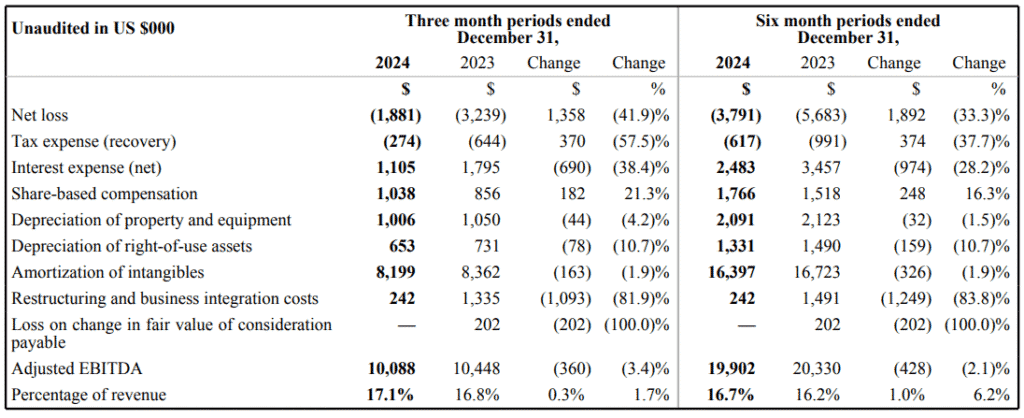
- Adjusted EBITDA2 of $10.1 million, representing 17.1% of total revenue, an improvement of 0.7% from the previous quarter.
- Enterprise resource planning (“ERP”) expenses of $0.6 million during the quarter, bringing second-quarter Adjusted EBITDA2 to $10.7 million excluding this investment.
- Churn rate improved to less than 1.0%
- Net loss significantly reduced to $1.9 million from $3.2 million in fiscal 2024 second quarter.
- Net cash provided by operating activities of $11.9 million, an increase of 29.7% over the same quarter last year.
- Net cash provided by operating activities as a percentage of second-quarter Adjusted EBITDA2 reached 118.1%, a significant increase from 87.9% in the same quarter last year and the fourth consecutive quarter in which it exceeded 100%.
- Successfully reduced our debt to $55–60 million two quarters ahead of schedule, with total debt of approximately $60 million at quarter-end.
- Cash at the end of fiscal 2025 second quarter was $17.1 million, reflecting strong quarterly operating cash flow progress, primarily driven by increased efficiency initiatives and effective working capital management.
Revised Fiscal 2025 Outlook3
Sangoma is taking decisive steps to advance its core platform strategy by accelerating strategic alternatives for certain low-margin, non-core product lines, including its third-party hardware resale operations. This strategic realignment, while reducing projected fiscal 2025 revenue, is expected to result in substantial improvements in both gross margin and Adjusted EBITDA2 margin.
Due to the discontinuation of certain non-core product lines, Sangoma is reducing its revenue outlook from the range of $250 million to $260 million to $235 million to $240 million, while maintaining a target of Adjusted EBITDA2 of at least 17% of revenue. Accordingly, the company now expects Adjusted EBITDA2 of $40 million to $42 million, compared with its previous outlook of $42 million to $46 million.
Conference Call
Sangoma will host a conference call on Wednesday, February 5, 2025, at 5:30 p.m. (ET) to discuss these results. The call-in number is 1‑844‑763‑8274 (International +1‑647‑484‑8814), and the participant access code is 8503464#. Participants are asked to dial in 5 minutes before the scheduled time and request to join the Sangoma Technologies call.
1 Operating expenses include sales and marketing, research and development, general and administrative expenses, and amortization of intangible assets.
2 Adjusted EBITDA is a non-IFRS financial measure used by the Company to monitor its performance. Please see the section entitled “Non-IFRS Measures and Reconciliation of Non-IFRS Measures” in this press release for how we define “Adjusted EBITDA”.
3 The information in this section is forward-looking. Please see the section entitled “Cautionary Statement Regarding Forward-Looking Information” in this press release.
About Sangoma Technologies Corporation
Sangoma (TSX: STC; Nasdaq: SANG) is an enterprise communications platform provider with solutions including its award-winning UCaaS, CCaaS, CPaaS and trunking technologies. Its enterprise-grade communications suite is developed in-house and is available for cloud, hybrid or on-premises deployments. In addition, Sangoma offers managed services for connectivity, networking and security. A trusted partner for more than 40 years, Sangoma has more than 2.7 million UC seats among a diverse base of more than 100,000 customers. Sangoma has been recognized for nine consecutive years in the Gartner UCaaS Magic Quadrant. As the developer and primary sponsor of the Asterisk and FreePBX open source projects, Sangoma is committed to continuously driving innovation in communications technology. For more information, visit www.sangoma.com.
Cautionary Statement Regarding Forward-Looking Statements
This press release contains forward-looking statements, including statements concerning the future success of our business, development strategies and future opportunities.
Forward-looking statements are provided to present management’s current expectations and plans regarding the future, and readers are cautioned that such statements may not be appropriate for other purposes. Forward-looking statements include, but are not limited to, statements relating to management’s guidance on revenue and Adjusted EBITDA, statements relating to expected future production and cash flows, and other statements that are not historical facts. When used in this document, words such as “may,” “plan,” “estimate,” “expect,” “will,” “intend,” “could,” “potential,” “should” and similar expressions indicate forward-looking statements.
Although Sangoma believes that its expectations reflected in these forward-looking statements are reasonable, these statements involve risks and uncertainties, and no assurance can be given that actual results will conform to them. Forward-looking statements are based on management’s opinions and estimates as of the date the statements are made and are subject to a variety of risks and uncertainties and other factors that could cause actual events or results to differ from those projected in the forward-looking statements.
Readers are cautioned not to place undue reliance on forward-looking statements, as there can be no assurance that the plans, intentions or expectations on which they are based will be realized. By their nature, forward-looking statements involve numerous assumptions, known and unknown risks, both general and specific, that contribute to the possibility that the forecasts, projections and other events contemplated by the forward-looking statements will not occur. Although Sangoma believes that the expectations reflected in these forward-looking statements are reasonable, there can be no assurance that these expectations will prove correct, as they are inherently subject to business, economic and competitive uncertainties and contingencies. Some of the risks and other factors that could cause results to differ materially from those expressed in the forward-looking statements contained in this document include, but are not limited to, risks and uncertainties related to fluctuations in exchange rates between the Canadian dollar and other currencies (particularly the US dollar), technological changes, changes in economic climate, changes in macroeconomic conditions, including (i) inflationary pressures and potential recessionary conditions, as well as actions taken by central banks and regulators around the world to reduce, limit and address these pressures and conditions, including any increase in interest rates, and (ii) the effects of adverse developments in financial institutions, including bank failures, that affect general sentiment regarding the stability and liquidity of banks, and the resulting impact on the stability of global financial markets generally, risks related to any pandemic or epidemic, our ability to identify and effectively remediate material weaknesses and significant deficiencies in our internal controls, our current level of indebtedness and our ability to incur additional short- and long-term indebtedness; changes in the regulatory environment, the imposition of tariffs, the declining importance of the PSTN (as defined in our MD&A), goodwill amortization and new competitive pressures, political unrest, geopolitical instability and tensions, or terrorist attacks, and changes associated with global trade policies and economic sanctions, including, but not limited to, in connection with (x) the ongoing conflict in Ukraine (the “Russo-Ukrainian War”) and (y) any impact, effect, damage, destruction and/or bodily injury directly or indirectly related to the ongoing hostilities in the Middle East, and technological changes affecting the development of our products and the implementation of our business requirements, including with respect to automation and the use of artificial intelligence (“AI”), and the other risk factors described in our latest annual information form for the fiscal year ended June 30, 2024.
Our forecasts are based on the Company’s assessment of numerous important assumptions, including:
- The Company’s ability to manage current supply chain constraints, including our ability to secure electronic components and parts, manufacturers being able to deliver the planned quantities of finished products, no further material increase in electronic component costs, and no significant increase or material delay in shipping costs
- Successful transformation of the Company’s go-to-market strategy
- Revenue trends the Company has experienced in fiscal 2025 to date, trends we expect going forward in fiscal 2025, the impact of our go-to-market strategy transformation and the impact of increasing global economic headwinds
- The continued effects of recent macroeconomic factors such as inflation, interest rates, recessions, invasions or declarations of war, and a significant decline in US government spending
- Continued growth in the global UCaaS and cloud communications markets generally
- Subscriber demand and growth for our Services and continued expected demand for our Products
- The impact of global exchange rate fluctuations on demand for the Company’s products and services
- The ability of the Company’s customers to continue their business operations without a material impact on their requirements for the Company’s products and services
- The Company’s internal sales team and channel partners’ revenue forecasts will meet current expectations, which is based on certain management assumptions, including continued demand for the Company’s products and services, no material delays in receiving products from its contract manufacturers, and no further increases in manufacturing, labor or shipping costs
- That the Company can attract and retain the employees needed to maintain its current pace
- Timely implementation of our ERP in accordance with our forecast budget
Non-IFRS Measures and Reconciliation of Non-IFRS Measures
This press release contains references to Adjusted EBITDA, a non-IFRS financial measure. Non-IFRS financial measures are used by management to evaluate the Company’s performance and have no meaning prescribed by IFRS and are therefore not comparable to similar measures presented by other issuers. The non-IFRS financial measures used here have been applied consistently. “Adjusted EBITDA” means earnings before taxes, interest (net), share-based compensation, depreciation (including right-of-use assets), amortization, business restructuring and integration costs, goodwill impairment and change in the fair value of contingent consideration payable. Adjusted EBITDA is a measure used by many investors to compare issuers. We believe Adjusted EBITDA is useful supplementary information because it provides an indication of the results generated by the Company’s principal activities before taking into account how they are financed, taxed, depreciated or amortized. Investors are cautioned that non-IFRS financial measures, such as Adjusted EBITDA, should not be interpreted as an alternative to net income or cash flow determined in accordance with IFRS. The IFRS measure most directly comparable to Adjusted EBITDA presented in our financial statements is net income.
The following table reconciles Adjusted EBITDA to net income for the periods indicated:
Sangoma Technologies Corporation
Larry Stock
Chief Financial Officer