
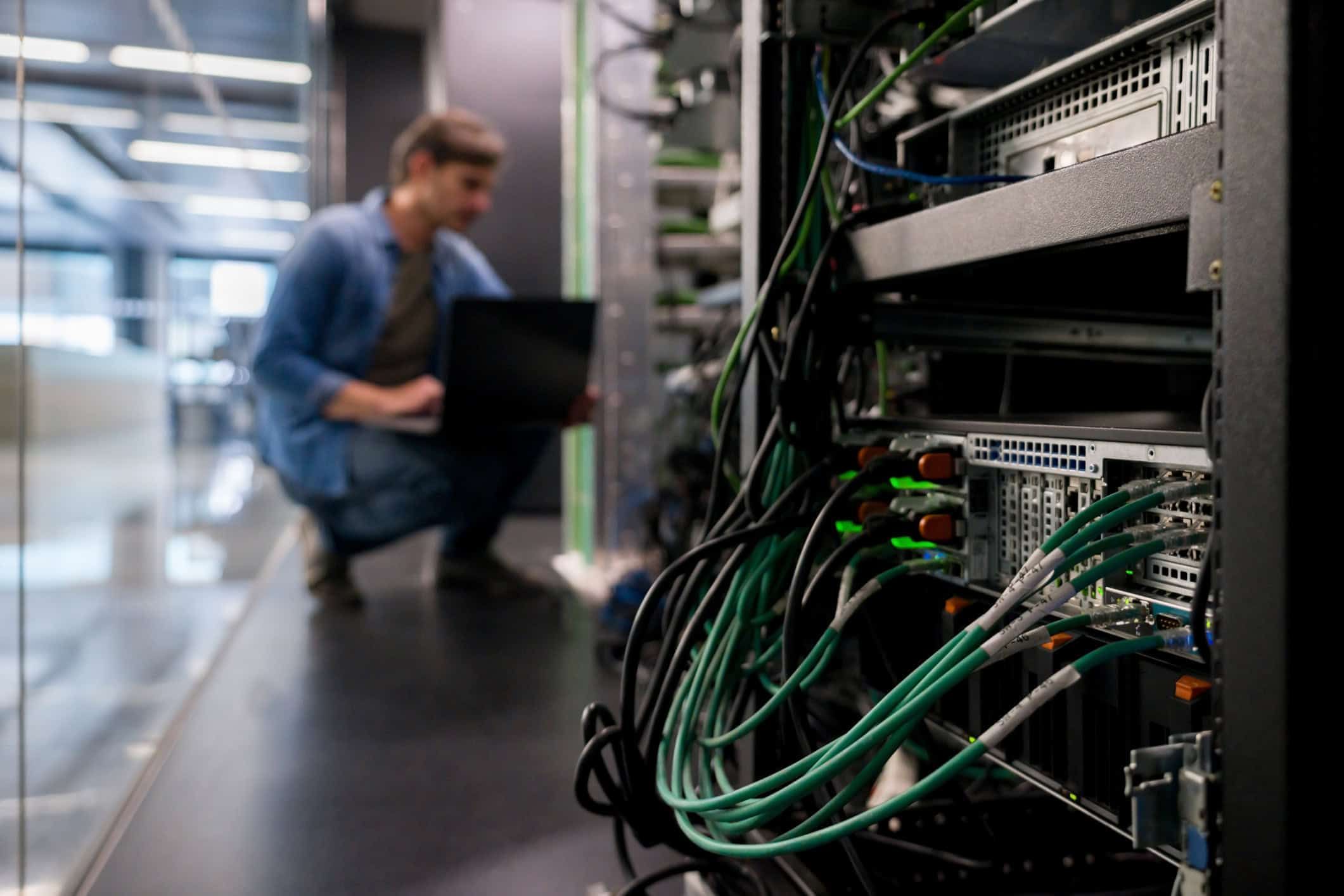
AI tools may reside in the cloud, but their performance still depends on your company’s internal network. If you plan to use AI meeting transcription, AI voice agents, real-time assistants, or other AI applications, your network needs sufficient bandwidth, low latency, reliable connectivity, robust security, and backup solutions to keep these tools running.
Your network is one of the first things to check before adding more AI. A solid foundation helps AI applications respond quickly while keeping phone calls, meetings, cloud applications, and other tools your business already relies on running smoothly.
What is an AI-ready business network?
An AI-ready network is a business network capable of moving the data required by AI applications quickly, reliably, and securely. It includes the Internet connections, switches, Wi-Fi, security, routing, and backup connectivity that link employees, devices, cloud services, and AI applications.
Most business networks were designed around familiar tasks such as email, web browsing, file sharing, phone calls, and video meetings. AI adds more traffic to this infrastructure, often while processing and exchanging information in real time. This increases the importance of low latency, high availability, consistent bandwidth, and reliable connections between sites.
See also: Why AI starts with your network
Why does AI voice infrastructure put extra pressure on your network?
AI voice must recognize speech, understand intent, generate a response, and return audio quickly enough to keep the conversation natural. It must also handle turn-taking, interruptions, latency, speech recognition, and telephony infrastructure simultaneously.
AI agents can also perform tasks much faster than humans. Imagine someone calling reception to place an order that requires information or actions from four different departments. A person would need to make calls, send messages, wait for replies, and transfer the request from one team to another. An AI agent can coordinate most of these steps almost instantly, eliminating much of the waiting time inherent in a human process.
This speed can lead to a major increase in activity across your systems. An AI agent can make queries, access data, update applications, and trigger other actions in seconds, generating more network traffic in a much shorter period. As businesses use more AI agents simultaneously, the infrastructure supporting them must keep pace.
Latency is particularly critical for voice AI. Latency is the time it takes data to travel from one point to another, and high latency can cause pauses that make an AI conversation feel slow or artificial. Jitter can also cause audio packets to arrive at irregular intervals, affecting AI voice agents, AI meeting transcription, and other applications that process speech in real time.
For an AI voice agent connected to a business phone system, every conversation and the actions it triggers depend on a network, telephony infrastructure, and other systems operating quickly and reliably. As AI takes on more work in less time, network performance becomes an increasingly important factor in the quality of these applications.
Why are AI network requirements becoming more important?
Businesses are integrating voice AI into their daily operations at a rapid pace. According to AI Voice Research, production deployments of voice agents increased by 340% year over year, based on deployment data from more than 500 organizations.
Market research also indicates significant growth ahead. Estimates put the global AI voice agent and infrastructure markets at around $2.4 trillion to $5.4 trillion today, with projections ranging from $47.5 trillion to $133.3 trillion over the next decade.
This growth means more AI traffic flowing across enterprise networks. AI voice agents, AI meeting transcription, conversational intelligence, automated customer service, and other applications all depend on the infrastructure connecting users, devices, data, and cloud services.
What happens if your network is not ready for AI?
Network performance problems become more visible when businesses add applications that require real-time processing. Three areas deserve particular attention.
Latency and jitter can disrupt real-time AI
AI inference, meaning running an AI model to produce a response, can happen in real time. Delays or inconsistent packet delivery can cause voice agents to pause, real-time translation to lag, computer vision to stall, or automated tools to freeze.
Legacy Quality of Service policies, or QoS, may also struggle to keep up with changing traffic patterns. AI workloads can then compete with phone calls, video meetings, cloud software, and other applications for available network resources.
Limited visibility makes troubleshooting more difficult
Legacy networks may provide fragmented logs across different devices, sites, and services. AI applications may run on local systems, cloud platforms, and multiple business sites, so IT teams need sufficient visibility to track performance across the entire journey.
Without this visibility, teams may spend more time locating the source of a slowdown or failure. Better network monitoring helps identify congestion, unstable connections, overloaded devices, and other problems before they affect more users.
Slow network changes increase the risk of outages
AI workloads can change as usage increases throughout the day or new applications are introduced. Networks need sufficient capacity and flexibility to handle these changes without constant manual intervention.
Heavy reliance on manual tickets and long change windows can make it harder to respond quickly to traffic or connectivity problems. This can lead to synchronization failures, application downtime, lost productivity, and interruptions to customer-facing services.
Is my network ready for AI?
Business owners can begin assessing AI network readiness without becoming network experts. The applications your employees already use can provide clues about how ready your network is to support more AI.
AI meeting transcription, a feature increasingly used by businesses, can give you insight into your network performance. During a meeting, audio must flow reliably between participants, the meeting platform, and the services processing the conversation. Poor Wi-Fi, low call quality, or unreliable connectivity can indicate problems that will become more visible when you add real-time AI applications.
Examine what your employees are already experiencing. Does your internet slow down during periods of high demand? Can your business stay online if its primary Internet connection fails? Can your network prioritize important traffic? Are older switches creating bottlenecks? Can your team see network performance at every site?
Next, look at how you manage your network. Bandwidth bottlenecks, wireless congestion, limited failover, and a fragmented network spread across multiple providers can make performance management more difficult as your AI usage increases.
Read more: Nobody is talking about the part of AI that actually matters
How can you prepare your network for voice AI and other AI applications?
Start with connectivity and capacity. Your Internet connection must have enough bandwidth to support growing AI workloads alongside phone calls, video meetings, cloud applications, file transfers, and daily business traffic.
Next, assess switching and local network capacity. Businesses handling larger amounts of local data may benefit from migrating from a 1 Gb infrastructure to a 10 Gb switch. High-capacity switching can support edge AI processing and a greater volume of data from cameras, sensors, endpoints, and local systems.
Also examine traffic management. SD‑WAN can intelligently route traffic across multiple connections and prioritize AI workloads while supporting other business applications. This is especially useful for companies with multiple offices, cloud services, or backup Internet connections.
Your Wi‑Fi and backup connectivity also need particular attention. Reliable wireless connectivity supports the growing number of laptops, phones, cameras, sensors, and other endpoints using AI applications, while backup 5G can provide a backup connection if the primary connection goes down.
Finally, integrate security into your AI network planning. AI applications can move customer information, recordings, transcripts, internal documents, and other sensitive data among users, sites, and cloud services. Integrated network security can help protect these data flows in distributed environments.
How can Sangoma help prepare your network for AI?
Sangoma’s Managed Network Services bring together connectivity, switching, SD‑WAN, managed Wi‑Fi, managed backup 5G, and managed security. These services can support high-capacity data flows, distributed sites, real-time applications, connected devices, and growing AI workloads.
As your business adds AI meeting transcription, voice agents, and other AI applications, reviewing the underlying infrastructure can help you identify bottlenecks and reliability issues early. Contact a Sangoma representative to review your current network and ensure your infrastructure is ready for the AI tools your business plans to use soon.